
Written by Kate Jamaica Nanao and Nahdia Wallang (QAO Staff)
The University of Baguio (UB), through the leadership of Educational Organization Management Representative (EOMR) and Vice President for Academic Affairs (VPAA) Dr. Janice Kaylyn K. Lonogan, successfully convened its leaders for “Professional Reinforcement for Innovation and Mentorship in Education (PRIME) Upskilling the Future: A Dialogue on Microcredentials and Evolving CHED Initiatives” on July 24, 2026, at the FGB Hall.
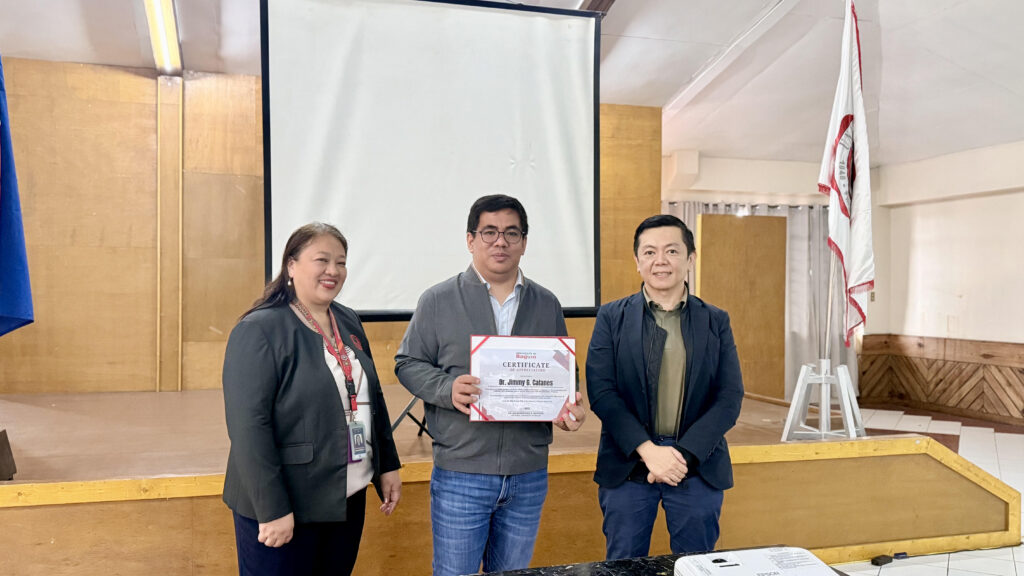
The high-level dialogue featured Dr. Jimmy G. Catanes, Director IV of the Office of Programs and Standards Development (OPSD) at the Commission on Higher Education (CHED) Central Office, who shared comprehensive insights on the evolving national policy landscape on microcredentials, the Philippine Qualifications Framework (PQF), and strategic directions shaping the future of Philippine higher education.
The activity gathered 55 academic leaders, including members of the Management Team, Program Chairs, and Assistant Principals in a unified effort to strengthen institutional initiatives and align academic programs with national and international standards of quality and relevance.
The event was spearheaded by Dr. Kareen B. Leon, Director of the Quality Assurance Office (QAO), and Dr. Charesma Grace K. Lud-ayen, Dean of the School of Criminal Justice and Public Safety (SCJPS), in close collaboration with the EOMR/VPAA.
Microcredentials within the Philippine Qualifications Framework (PQF)

Central to Dr. Catanes’ discussion was the positioning of microcredentials, as outlined in CHED Memorandum Order (CMO) No. 1, series of 2025 within Republic Act (RA) No. 10968 or the Philippine Qualifications Framework (PQF) Act — the national law that institutionalizes the PQF to harmonize and articulate qualifications across education, training, and labor market systems. He emphasized that microcredentials serve as a vital mechanism under the PQF to recognize small-volume, skills-focused, and verifiable learning that is responsive to industry and societal needs. He further elaborated on the importance of the mapping of microcredentials and academic programs to the PQF.
Dr. Catanes also underscored the value of Tracer Studies in validating the relevance and impact of microcredentials and academic programs. As CHED continues to promote outcomes-based and data-driven quality assurance, tracer studies provide critical evidence on graduate employability, skills alignment, and curriculum effectiveness, guiding institutions in continuous improvement and program innovation.
The University should also continue leveraging the Expanded Tertiary Education Equivalency and Accreditation Program (ETEEAP) as a foundational strategy for recognizing prior learning and professional experience, according to Dr. Catanes. Aligned with the Philippine Qualifications Framework (PQF), ETEEAP provides a robust mechanism for professionals to validate their work-based competencies for academic credit, serving as a critical pathway for upskilling and degree completion. By rigorously mapping professional experiences against curriculum standards, UB ensures that a learner’s career background is formally acknowledged, effectively bridging the gap between industry practice and academic attainment. This integrated approach underscores the University’s commitment to delivering quality, innovation-driven education that is both nationally recognized and globally competitive.
The dialogue enabled UB to situate its academic and quality assurance priorities within both national regulatory frameworks and global benchmarks. Among the key alignment points discussed were:
• Strict compliance with existing CMOs and other regulatory issuances under the PQF Act;
• Integration of microcredentials into existing curricula and professional development programs through PQF level descriptors;
• Sustaining UB’s Autonomous Status and advancing institutional excellence initiatives;
• Enhancing performance in international quality and ranking frameworks such as QS Stars, WURI (World University Rankings for Innovation), and Times Higher Education (THE);
• Strengthening PACUCOA accreditation and other external quality assurance mechanisms through evidence-based improvements, including tracer studies; and
• Alignment with DepEd initiatives for teacher education and basic education programs.
Through PRIME, the University reaffirms its leadership in delivering quality, innovation-driven, and qualifications-aligned education — ensuring that every UBian learner and professional is equipped with competencies that are nationally recognized and globally competitive.