
Written by the Dr. Kareen Leon & Lenilyn Malicdem
Photos courtesy of Gabriel Madriaga (Linkages Office, Marketing and Promotions Unit)
The second day of the Professional Reinforcement for Innovation and Mentorship in Education (PRIME) and the Management Development Program – Strategic University Management for Mobilizing Institutional Transformation (MDP–SUMMIT) successfully convened deans, program chairs, and subject heads in a collaborative academic engagement aimed at advancing outcomes-based education, strengthening curriculum alignment, and reinforcing strategic institutional transformation initiatives. Held at the FGB Hall on May 26, 2026, which was intended to be in the morning session, the activity served as a platform for academic leaders to promote excellence in instructional delivery, curriculum development, and institutional governance. A total of 43 participants attended the activity, including the Vice President for Academic Affairs, Dr. Janice Kaylyn K. Lonogan, nine deans, 32 program chairs and subject heads, as well as the Quality Assurance Office (QAO) Director.
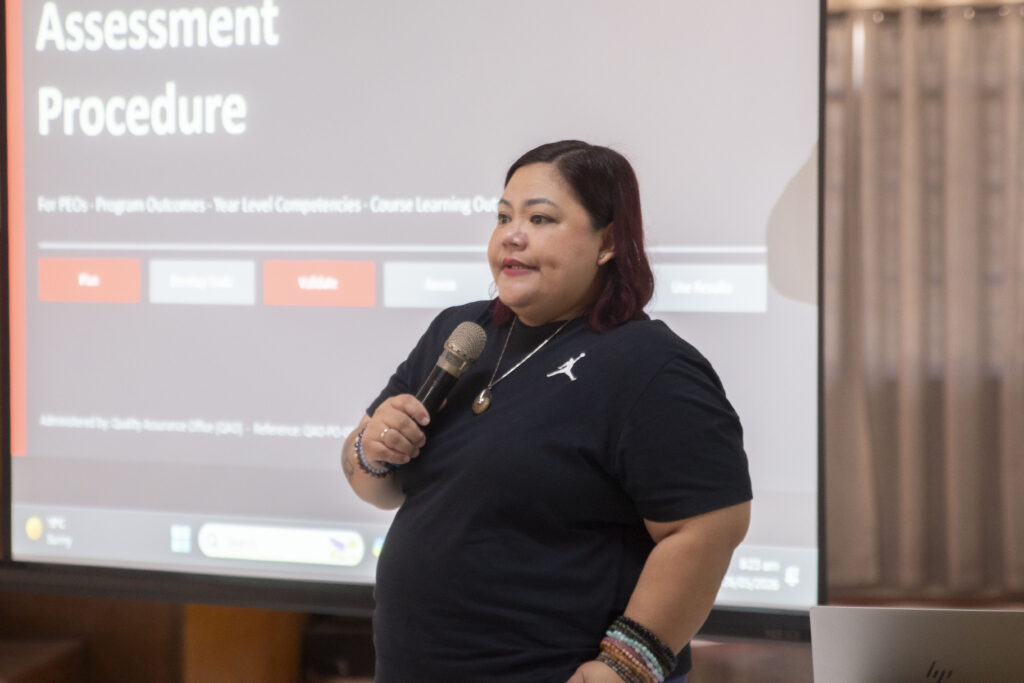
The session formally commenced with a comprehensive presentation by Dr. Charesma Grace K. Lud-ayen, the Dean of the School of Criminal Justice and Public Safety (SCJPS) and a seasoned Philippine Association of Colleges and Universities Commission on Accreditation (PACUCOA) Accreditor. She talked on the University’s assessment procedures and outcomes-based education (OBE) framework. The discussion focused on the alignment and measurement of Program Educational Objectives (PEOs), Program Outcomes (POs), Year Level Competencies (YLCs), and Course Learning Outcomes (CLOs). The presentation outlined the step-by-step assessment process, including planning, tool development and validation, assessment implementation, narrative reporting, and the utilization of results for curriculum review and continuous improvement. Special emphasis was given to constructive alignment, backward design, Bloom’s Taxonomy, and the systematic mapping of CLOs to Program Outcomes to ensure that instructional delivery, assessment practices, and curriculum design remain aligned with institutional goals and graduate competencies.
A major highlight of the session was the comprehensive workshop on PEO-PO-CLO Alignment, where participants engaged in curriculum review activities and collaborative discussions focused on strengthening the alignment among PEOs, POs, and CLOs. The workshop reinforced the principles of outcomes-based education through curriculum coherence, constructive alignment, and effective assessment mechanisms that support student learning and program attainment.
Through curriculum mapping and alignment exercises, participants critically examined course structures, learning outcomes, and assessment practices to ensure consistency between institutional goals, program objectives, and instructional delivery. The activity also provided an avenue for academic leaders to exchange best practices and identify opportunities for curriculum enhancement and continuous improvement.
The session likewise highlighted the University’s commitment to supporting the United Nations Sustainable Development Goals (SDGs), particularly Sustainable Development Goal 4 by promoting inclusive, equitable, and quality education through outcomes-based learning and continuous curriculum improvement, and Sustainable Development Goal 8 by strengthening graduate competencies, employability, and future-ready skills aligned with industry and societal needs.
The morning session reinforced the University’s commitment to academic quality, curriculum enhancement, and strategic institutional transformation while providing participants with meaningful opportunities to strengthen outcomes-based education practices and support the institution’s vision of delivering transformative and future-ready education.