

Advancing automation in practical, efficient ways to use artificial intelligence (AI) to transform and improve decision-making, the University of Baguio‘s School of Business Administration and Accountancy (SBAA) successfully conducted a webinar that highlighted how AI can improve efficiency and support simple financial processes within the finance and accounting industry.
The Practical Implications for Artificial Intelligence with Humanistic Direction
Participating students learned how AI is transforming accounting and finance. This included faster processing of financial records, invoices, and receipts, as well as enhanced analysis by spotting trends, unusual transactions, and financial projections. The conversation also covered three significant clusters within the implications:
- The evolution of AI assistants into AI agents
- The expanding availability of automation tools
- The growing demand for security measures like data privacy, approval processes, and audit trails
The event featured a distinguished resource speaker, Ms. Lorenza Pangkas-Baguiwa, CPA, who shared key perspectives on artificial intelligence’s expanding role in accounting and offered strategies for future professionals to navigate evolving technologies. A central point is that while AI streamlines financial tasks and boosts efficiency, using it effectively still requires accuracy, human oversight, and strict accountability. The five levels of automation:
Robotic Process Automation (RPA), Workflow Automation, AI-Assisted Automation, AI Agents, and Autonomous AI
were another significant topic covered. These levels showed how 21st-century advancements in technology have progressively evolved from carrying out basic repetitive tasks to performing more complex activities with greater independence. Furthermore, the dedicated webinar explored technology’s role in accounting, demonstrating how it can help classify financial transactions, extract information from invoices and contracts, summarize financial reports, and precisely identify unusual transactions that may require further investigation through a human touch and understanding.
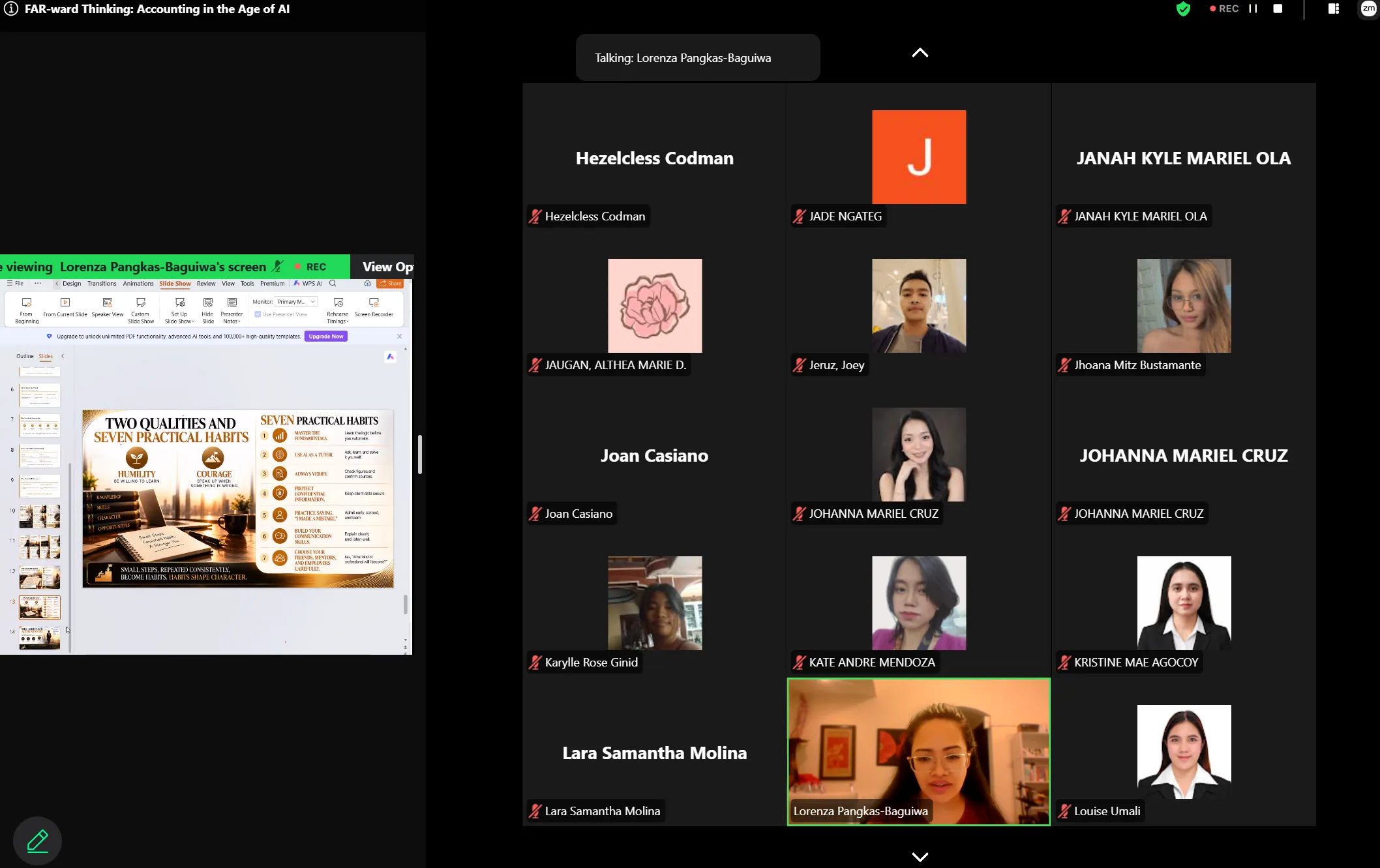
Alt Text: Highlights from the AI Webinar, led by the University of Baguio’s School of Business Administration and Accountancy
Helping practicing accountants and industry experts manage financial information and complete tasks more efficiently. However, the importance of verifying AI-generated information before making financial decisions was strongly emphasized. The discussion reminded participants that artificial intelligence-generated reports and information are not always accurate, as systems may produce incorrect classifications, overlook important details, or provide unreliable references.
Practicing professionals must uphold standards that exercise proper judgment by checking original documents, securing necessary approvals, maintaining confidentiality, and keeping accurate audit trails. Keep in mind the principles of integrity, objectivity, professional competence and due care, confidentiality, and professional behavior. Although AI can assist in preparing financial information, it cannot replace the accountability and professional judgment required of an accountant.
Moreover, the webinar supported the following United Nations Sustainable Development Goals (UN-SDGs):
- SDG 4: Quality Education – by providing participants with opportunities to gain knowledge about emerging technologies and develop relevant skills that prepare them for the changing demands of the accounting profession
- SDG 8: Decent Work and Economic Growth – by encouraging the development of technological skills and professional competencies that help prepare future accountants for evolving workplace demands and contribute to productivity and economic growth
- SDG 9: Industry, Innovation and Infrastructure – by promoting the use of artificial intelligence, automation, and innovative technologies to improve accounting processes and support digital transformation in the finance industry
Overall, the webinar offered insightful information about how accounting and finance are evolving in the era of artificial intelligence. It emphasized that participants who want to work in accounting can embrace technological innovations to consistently expand their knowledge, expertise, and capacity for critical thought. More significantly, it highlights that learning how to use technology responsibly while upholding the professional judgment, accuracy, and trust that characterize the accounting profession is more important for the future of accounting than competing with machines.
—
Written by: Bernadette Macayan | Kate Andre Mendoza
Article enhancement by Gabriel Madriaga


